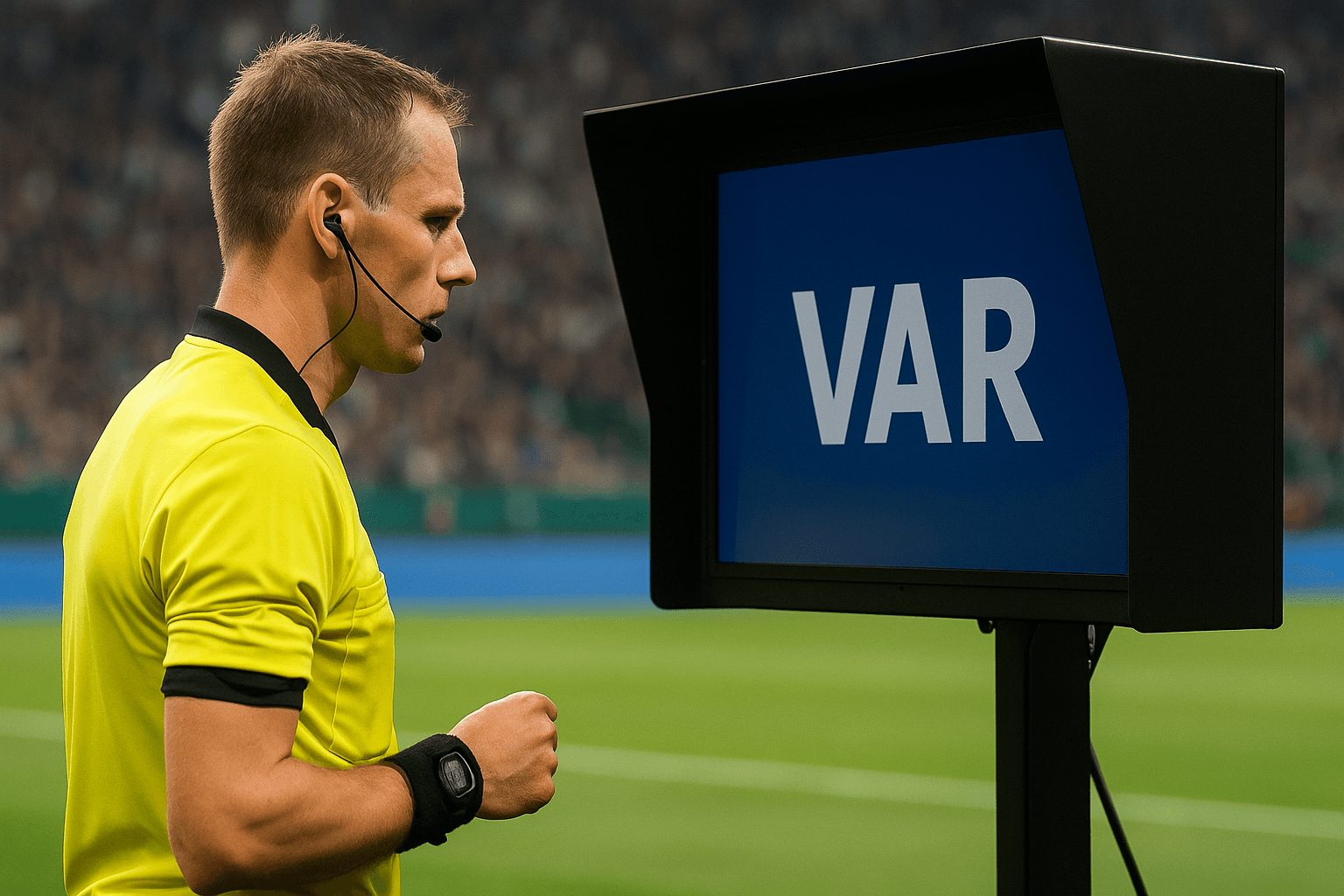

⚽ VAR System – In Which Situations Can It Be Used?
📝 Introduction
The VAR system has become a natural part of modern football matches. It is now a standard that referees have quickly adapted to, and fans have just as quickly grown accustomed to — both in stadiums and during television broadcasts. Its official debut took place at the 2018 FIFA World Cup in Russia, although VAR testing began two years earlier.
The first competitive match in which it was used was the first-round KNVB Cup fixture between Ajax and Willem II (5–0), played on September 21, 2016.
Several years have passed since VAR’s debut. Referees now use increasingly advanced and precise tools. The manual drawing of offside lines has been replaced by semi-automated offside technology, while the fundamental principles governing the use of VAR remain unchanged.
🎯 Use of the VAR System
The VAR Protocol within the Laws of the Game specifies that a video assistant may intervene only in the case of a clear and obvious error or a serious missed incident.
VAR may intervene in four categories of match incidents, which are:
🥅 Goal / No Goal
- an offence by the attacking team in the build-up phase or scoring of a goal (e.g., handball, foul, offside, etc.);
- the ball being out of play prior to the goal being scored;
- the decision to award or not award a goal;
- infringements by the goalkeeper and/or kicker during a penalty kick
(e.g., a double touch by the taker)
or premature encroachment into the penalty area by a teammate of the kicker or by a defending player who directly participates in play after the ball rebounds from the goalpost, crossbar, or goalkeeper
(e.g., a defender clears the ball out for a throw-in, preventing a follow-up shot on goal).
🧤 Penalty / No Penalty
- an offence by the attacking team in the build-up to the incident that led to the penalty being awarded (e.g., handball, foul, offside, etc.);
- the ball being out of play before the incident occurred;
- location of the offence (inside or outside the penalty area);
- a penalty incorrectly awarded;
- a missed offence that should have resulted in a penalty.
🟥 Direct Red Card (excluding second yellow cards / cautions)
- DOGSO – Denying an Obvious Goal-Scoring Opportunity; VAR particularly considers the position of the offence and the placement of other players;
- serious foul play (or reckless challenges);
- violent conduct, biting, or spitting at another person;
- use of offensive, insulting, or abusive actions or language.
🧍♂️ Mistaken Identity (in yellow or red card decisions)
If the referee shows a yellow or red card to the wrong player after a foul has been called, the identity of the offending player can be verified using video review.
The foul itself cannot be reviewed unless it is related to a later goal, a penalty/no-penalty decision, or a direct red card offence.
Frequently Asked Questions – FAQ
See also the second article, where I answer the most frequently asked questions about VAR, including Does VAR have the right to change the referee’s decision?
💡 Ideas for Improving the VAR System
VAR was introduced to eliminate clear and obvious referee mistakes — and it has succeeded in that respect. Today, goals scored by hand, like Maradona’s “Hand of God”, are impossible under the scrutiny of dozens of cameras tracking every player’s movement.
However, as football becomes faster and more dynamic, some fouls are harder for on-field referees to spot in real time. This can lead to a situation where the main referee, who should have the final word, becomes overly dependent on VAR officials.
At times, a referee may mistakenly award a corner kick or throw-in, and the attacking team scores from it. In such cases, VAR is powerless, because each restart of play begins a new phase of play. This means video assistants cannot review incidents prior to the restart.
This can lead to absurd situations where a referee must allow a goal that originated from their own mistake.
A simple solution would be for VAR to proactively alert the referee to such an error so that it can be immediately corrected before play resumes.
Another interesting idea for improving VAR is to introduce challenges for both team coaches — a system already functioning successfully in sports such as volleyball, basketball, and ice hockey.
📚 References:
compiled from: